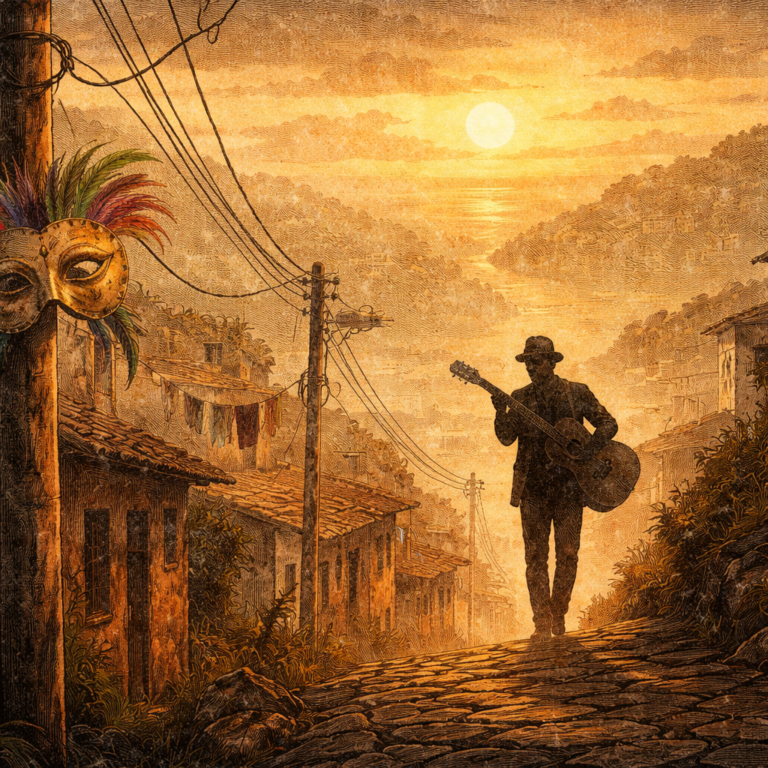
Baden Powell: The Virtuoso of the Guitar

🌍 Baden Powell: O virtuoso do violão
The guitarist who pushed Brazilian music to its limits — one impossible chord at a time. O violonista que levou a música brasileira ao seu limite — um acorde impossível de cada vez.
The Hands That Redefined the Violão
At the heart of bossa nova and modern Brazilian music stands a figure of almost mythical technical power: Baden Powell de Aquino.
A child prodigy who became one of the greatest guitarists of the 20th century, Baden Powell took the Brazilian violão to places it had never been. His playing was marked by extraordinary speed, dazzling harmonic invention, and a deep command of both classical technique and popular Brazilian rhythm.
His name, given by his father to honor the founder of the Boy Scouts, proved prophetic. Baden conquered the musical world with the discipline of a scout and the imagination of a poet.

The Prodigy From Rio
Baden Powell was born in Varre-e-Sai, in the interior of Rio de Janeiro, in 1937.
His family moved to Rio when he was still young, and he grew up surrounded by music. His father, an amateur guitarist, encouraged his talent, and Baden began playing seriously as a child. By the age of 13, he had already appeared on radio shows, astonishing audiences with his advanced technique.
He studied classical guitar formally, but his heart was in the popular music of Brazil — the samba, the choro, the rhythms of the street. From a young age, he was creating a bridge between the concert hall and the roda.
The Dialogue With Vinicius
Baden Powell’s most celebrated collaboration was with the poet and musician Vinicius de Moraes.
In the 1960s, the two created a landmark body of work that explored the African roots of Brazilian music. Their 1966 album Os Afro-Sambas was a revelation — a fusion of samba, the Afro-Brazilian rhythms of Bahia, and the harmonic sophistication of bossa nova.
Songs like “Canto de Ossanha,” “Canto de Xangô,” and “Lapinha” became classics. The album married Vinicius’s poetic lyricism with Baden’s masterful guitar work, creating a sound that was both ancestral and modern — a deep exploration of Brazil’s spiritual and musical heritage.

The Virtuoso’s Universe
Baden Powell’s solo guitar work is a universe unto itself.
His virtuosity was staggering. He could play with the speed of a flamenco guitarist and the harmonic depth of a classical master, all while swinging with the rhythm of samba. His improvisations were dazzling, his chord voicings inventive, his tone warm and varied.
He recorded extensively throughout his career, both as a soloist and with bands. His interpretations of Brazilian standards — as well as his original compositions like “Samba Triste” and “Deve Ser Amor” — remain benchmarks of guitar technique.

The Genius That Wandered
Baden Powell’s career was extraordinary, but his life was complex.
He lived in several countries, including France and Switzerland, and traveled the world bringing Brazilian guitar to international audiences. He was celebrated by guitar virtuosos and classical musicians alike, receiving honors and recognition for his contributions.
But he also struggled with personal difficulties, including health problems and the pressures of a demanding career. His later years were marked by illness, and he passed away in 1999, at the age of 62.
A Legacy Carved in Strings
Baden Powell left behind a body of work that has influenced generations of guitarists in Brazil and around the world.
Every serious guitarist of Brazilian music has studied his recordings. His harmonic language, his rhythmic command, and his sheer technical brilliance continue to set the standard. He expanded the violão from an accompaniment instrument into a complete world of expression.
Baden Powell proved that the Brazilian guitar could be a concert instrument of the highest order — capable of the deepest sentiment and the most dazzling display. His hands moved the world, one impossible chord at a time.
🇧🇷 RESUMO EM PORTUGUÊS (3-4 parágrafos)
No coração da bossa nova e da música brasileira moderna está uma figura de poder técnico quase mítico: Baden Powell de Aquino. Prodígio que se tornou um dos maiores violonistas do século XX, levou o violão brasileiro a lugares nunca antes vistos. Sua execução era marcada por velocidade extraordinária, invenção harmônica deslumbrante e profundo domínio tanto da técnica clássica quanto dos ritmos populares brasileiros.
Baden nasceu em Varre-e-Sai, interior do Rio, em 1937. Seu pai, violonista amador, incentivou o talento do filho. Aos 13 anos, Baden já se apresentava em programas de rádio, surpreendendo o público com técnica avançada. Estudou violão clássico formalmente, mas seu coração estava na música popular. Desde jovem, criava uma ponte entre a sala de concerto e a roda.
Sua colaboração mais célebre foi com Vinicius de Moraes. Em 1966, os dois lançaram Os Afro-Sambas, uma revelação — fusão de samba, ritmos afro-brasileiros da Bahia e a sofisticação harmônica da bossa nova. Canções como “Canto de Ossanha” e “Lapinha” tornaram-se clássicos. O álbum casou o lirismo poético de Vinicius com a mestria de Baden, explorando profundamente a herança espiritual e musical do Brasil.
O violão solo de Baden é um universo próprio. Sua virtuosidade era impressionante — velocidade de flamenco, profundidade harmônica clássica, tudo com o swing do samba. Gravou extensivamente e levou o violão brasileiro ao mundo, vivendo na França e na Suíça. Faleceu em 1999. Baden provou que o violão brasileiro podia ser instrumento de concerto da mais alta ordem — capaz do sentimento mais profundo e do espetáculo mais deslumbrante.